
AI and ADHD: Can Artificial Intelligence Really Help?
Feb 13, 2026
Artificial intelligence is changing how adults manage executive function challenges. For men diagnosed later in life—especially in midlife—tools like ChatGPT and Claude can feel like both a breakthrough and a question mark.
The relationship between AI and ADHD is powerful—but it’s not simple. Some tasks get dramatically easier. Others don’t change at all.
Watch: How AI Can Help ADHD Brains
Prefer reading? The full breakdown continues below.
How Artificial Intelligence Supports the ADHD Brain
Artificial intelligence is particularly strong at logic-driven tasks: organizing information, summarizing notes, categorizing ideas, and generating structured lists. According to the Stanford AI Index Report, AI systems continue to improve in structured reasoning and data processing—exactly the kinds of functions that often tax ADHD working memory.
For adults navigating executive dysfunction, that matters.
Let’s look at three practical ways this plays out.
AI and ADHD can work together in powerful ways
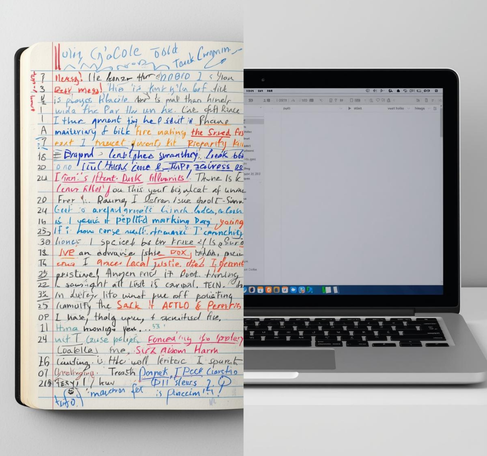
AI can transform scattered handwritten notes into structured themes and clear action steps.
If you live with ADHD, you probably have notes everywhere—notebooks, sticky notes, voice memos, half-finished documents.
One of AI’s greatest strengths is turning chaos into structure.
When I dropped a messy set of handwritten coaching notes into an AI tool and asked it to organize them, it returned:
-
A clear title
-
A logical structure
-
Thematic groupings
-
Highlighted action points
Was it perfect? No.
Was it dramatically easier to work with than a jumble of paper? Absolutely.
For adults who struggle with executive organization, this kind of clarity reduces friction immediately. AI doesn’t replace thinking—but it scaffolds it.
Untangling mental clutter with AI and ADHD

Externalizing thoughts through voice processing can reduce mental clutter for adults with ADHD.
Another common challenge is the mental “open loop” problem. Tasks sit in your head:
-
Follow up with a client
-
Finish a house project
-
Update your website
-
Remember someone’s birthday
-
Start a new idea
When I dictated a stream of thoughts into an AI tool and asked it to prioritize, it broke everything into:
-
Immediate action
-
This-week tasks
-
Creative or strategic items
It even suggested what could be done in the next 30 minutes to reduce mental static.
The recommendations weren’t flawless. But they created breathing room.
Externalizing your thoughts into structured categories reduces cognitive load. For many adults with ADHD, that shift alone can lower overwhelm.
AI functions as an external processor—something many of us have needed for decades.
AI support for complex life decisions
The third example is more emotionally loaded.
Many adults in midlife aren’t just managing their own lives. They’re helping aging parents navigate major transitions. When I needed to explore assisted living options for a relative, I didn’t know where to begin.
An AI-generated checklist helped organize:
-
Levels of care
-
Financial considerations
-
Medical needs
-
Facility comparison criteria
Having everything synthesized in one place helped me orient quickly.
But here’s the important part.
Even with a beautifully organized checklist, I still couldn’t start making calls.
Because organization isn’t the same thing as action.

Where Technology Stops — and Support Begins
Artificial intelligence can clarify.
It can categorize.
It can prioritize.
But it cannot reduce shame.
It cannot confront avoidance.
It cannot sit with you in fear.
Many intelligent, capable adults reach this point and think:
“I have the information. Why am I still stuck?”
If that question feels familiar, it’s not an intelligence issue. And it’s not a motivation problem.
It’s usually a support gap.
If you recognize yourself in that pattern—thoughtful, informed, capable, yet unable to move—that’s exactly the space I work in with men diagnosed in midlife.
You don’t necessarily need more tools.
You need structured accountability and someone who understands how ADHD actually operates in real life.
If that sounds like what you’ve been missing, you can schedule a free introductory session here.
We’ll simply explore whether coaching makes sense for you.
Artificial intelligence is an extraordinary tool. Used well, it can reduce friction and lighten cognitive load.
But transformation still happens in relationship.
And that’s a very human thing.
Please stay connected.
Join our mailing list to receive helpful and actionable information on ADHD and coaching.
We hate SPAM. We will never sell your information, for any reason.